Should Future MES Be AI-Native by Design?
Adding AI agents on top of existing MES can be a good starting point. But there may be a limit to that approach. The deeper question is whether future MES should be designed around AI from the very beginning.
Recently, while exploring and implementing AI agents on top of existing manufacturing systems, one thought became stronger for me.
There may be a limit to simply adding AI to existing systems.
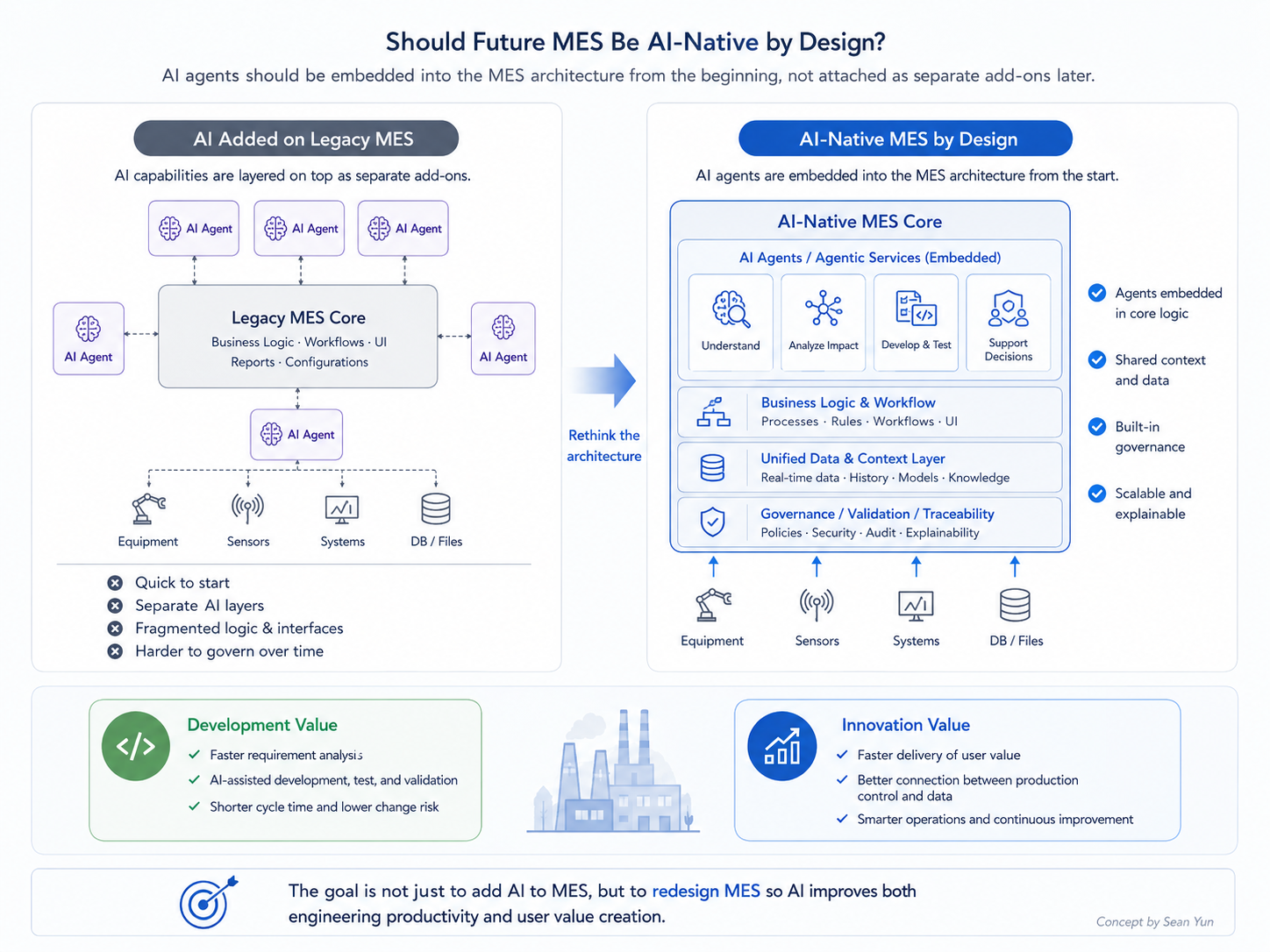
The Value — and the Limit — of Adding AI on Top
Of course, attaching AI agents to existing MES or manufacturing systems has clear advantages.
It allows us to start quickly. AI agents can help users retrieve existing data, answer questions, automate parts of work, and support analysis or documentation. These are valuable use cases.
But at the same time, I started to think about another issue.
If we continue adding AI agents on top of existing system structures, we may eventually create another layer of complexity.
Each agent may interpret data differently. Some agents may bypass existing logic or interfaces. Others may operate separately from the original system architecture. Over time, the overall architecture may become even more complex and harder to manage.
In other words, we may add AI — but end up creating another complicated layer.
I believe this is an important point when thinking about the future of MES.
The Question That Matters More
The question is not simply: "How do we add AI agents to existing MES?"
The more important question may be: "Should future MES be designed from the beginning around AI agents?"
I see two major purposes that shape my answer.
Development Value
Manufacturing systems constantly change.
New requirements emerge. Shop-floor operating methods change. Equipment and process conditions change. Users want faster functional improvements.
But in the traditional approach, the time required for requirement analysis, impact assessment, design, development, testing, validation, and deployment continues to increase.
I believe AI-native MES should be designed to make this development cycle faster and safer. It should help understand operational requirements, analyze existing logic and data structures, assess change impact, suggest minimal improvement approaches, and support test scenarios and validation processes.
The development loop itself becomes part of what the system is designed for — not something layered on top afterward.
Innovation Value
MES is not simply a system that records production.
In an automated factory, MES sits at the center of production control and data connection. If MES is designed as AI-native, users should be able to gain insights from data faster, make operational decisions more safely, and experience new value more quickly.
In other words, AI-native MES should not be only a tool that helps developers. It should become an operational platform that delivers value to users faster.
Why This Is Hard — and Why That Makes It Important
I now believe we need to move beyond "adding AI to MES" and start rethinking MES architecture from the beginning around AI agents.
Of course, this is not easy.
Manufacturing systems require control, traceability, validation, governance, and human approval. These are not constraints to work around. They are the reasons the system exists.
But that is exactly why I believe the AI-native-by-design perspective is important.
Where agents understand data, how they reference business logic, within what guardrails they make suggestions, and how they connect to validation and deployment — all of this should be part of the architecture from the beginning.
Otherwise, AI agents may not become the future solution. They may become the beginning of another layer of complexity.
Two Paths Forward
Between adding AI agents on top of existing systems and designing systems to be AI-native from the beginning, I believe the direction matters more than the speed.
Starting with add-on AI is not wrong. But if the underlying architecture is never reconsidered, the accumulated complexity will eventually outpace the value AI was supposed to deliver.
To me, AI-native MES is not about simply replacing existing MES. It is an experiment in a new manufacturing system architecture that can improve both development productivity and user value productivity.
The goal is not just to add AI to MES, but to redesign MES so AI improves both engineering productivity and user value creation.
Where do you see the limits of adding AI on top of existing systems? I'd like to hear your perspective — find me on LinkedIn.