What Does AI-Native Manufacturing Really Mean?
AI-enabled and AI-native are not the same thing. The difference is not about which tools you use — it is about how the system is designed to work with AI from the ground up.
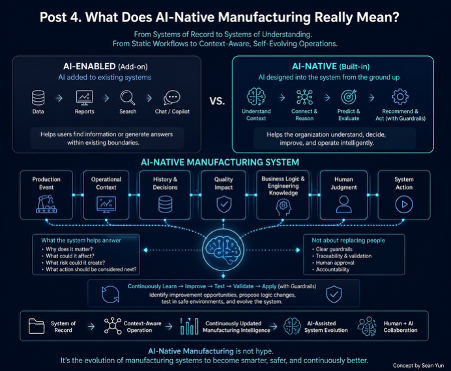
These days, many manufacturing systems are becoming AI-enabled.
AI is being used in areas such as report generation, data search, troubleshooting support, code generation, document summarization, and decision support. These use cases are valuable.
But I believe AI-enabled and AI-native are not the same thing.
AI-enabled means adding AI capabilities on top of an existing system. AI-native means designing the system from the beginning so that AI can help the system understand context, support decisions, improve itself, and operate more intelligently.
In manufacturing, this distinction matters.
How Traditional Systems Were Designed
Traditional manufacturing systems have usually been designed around transactions, rules, workflows, and system integrations.
They record what happened. They execute predefined logic. They pass events to other systems. They provide history for analysis.
This architecture has worked effectively for a long time.
But as I discussed in my previous posts, manufacturing operations are becoming increasingly complex. The shop floor is no longer as deterministic as system diagrams suggest. Exceptions and business logic continue to accumulate. Understanding and changing the system becomes more difficult over time.
The Right Question
So I do not think the key question is simply: "How can we add AI to MES?"
The more important question may be: "How should manufacturing system architecture evolve if AI becomes part of the operating model?"
To me, AI-native manufacturing architecture is not just about adding a chatbot or copilot on top of existing systems.
What Future Systems Need to Connect
Future manufacturing systems need to connect these elements more effectively:
- Production event
- Operational context
- Historical decision
- Quality impact
- Business logic
- Engineering knowledge
- Human judgment
- System action
In other words, the system should not only tell us what happened.
It should help us understand:
- Why does it matter?
- What could it affect?
- What risk could it create?
- What action should be considered next?
AI Should Augment, Not Replace
This does not mean AI should replace engineers or operators.
Manufacturing systems still require control, traceability, validation, accountability, and human judgment. That is why AI-native manufacturing must be designed within clear guardrails.
AI should not replace people. It should help make complex operational knowledge and system logic more visible, more connected, and more actionable.
And eventually, I hope manufacturing systems can evolve further. Based on accumulated operational context and business logic, systems may be able to identify improvement opportunities, suggest logic improvements, and test and validate them in a safe environment.
Of course, this should not be uncontrolled automation. It should happen within clear guardrails, traceability, validation, and human approval.
The Direction I See
I believe future manufacturing systems may evolve in this direction:
- From systems of record, to systems of understanding
- From static workflows, to context-aware operations
- From scattered knowledge, to continuously updated manufacturing intelligence
- From manual impact analysis, to AI-assisted system evolution
And in the long term, I believe manufacturing systems can evolve into a new operational architecture where humans and AI work together to understand operational knowledge, improve system logic, and safely validate and apply changes.
To me, AI-native manufacturing architecture is not AI hype.
It is an architectural question about how manufacturing systems can evolve more safely, intelligently, and continuously with the realities of the shop floor.
This is the direction I am exploring through this series.
How do you define "AI-native" in industrial or manufacturing environments? I'd like to hear your perspective — find me on LinkedIn.